With over 80,000 electric vehicles (EVs) now on the road, (nearly 120,000 if you include plug-in hybrids) it might seem that New Zealand’s car owners are generally keen to get onboard with ‘clean’ transport. Thanks to the government’s generous rebate scheme and more choice of EVs, including some lower-priced entry models, the market boomed from 2022. However, with the end of the rebates and the start of road taxes (matching diesel vehicle rates), 2024 saw a decline in demand. Many motorists also still have some significant practical reservations.
The main concerns proving to be a barrier to committing to an EV remain costs and charging. Specifically, the cost of purchasing an EV, the distance it can travel and the availability and convenience of charging points.
While we can’t subsidise your next car purchase, or install you a free, mobile, charging point, we can at least give you a realistic, current overview of these issues and point you to the best advice on the web…
While premium EV models are still more expensive than their traditional-fuelled counterparts, the last few years have seen many affordable models being introduced into the market. At the time of publishing, the cheapest EV available in New Zealand is the 39kWh Nissan Leaf, which you can purchase for just under $30,000 (the newer e+ variant with a 59kWh battery is closer to $37,000). Nissan’s equivalent petrol Nissan Juke starts at just under $36,000. While the cheaper version of the Leaf is far from the best EV tech available today, it still offers a 270km range and comes with a full warranty and other new car benefits.
The market is already far more competitive than people predicted and while all the initial purchase subsidies have finished, there are EV deals to be had and the relatively lower running costs mean long term savings.

If, for the size and type of car you need, the initial pay-out is still a barrier to purchasing new, there is of course a growing market of second-hand EVs and plug-in hybrids. This may be a more affordable and/or viable way to dip your feet into EV ownership. However, make sure you do your research on the model you’re purchasing – EV tech has come a long way in a short period of time and it may be a false economy if you are buying an old battery.
Back to costs! As well as the Rego fee you have to pay (of which EVs is on the same rate as petrol private passenger cars – 3 months at
$40.47 / 6 months at $72.26 / 12 months at $135.84), from April 2024, EV owners have had to pay for Road User Charges (RUC). The fee is dependent on the type of EV you own:
While EV owners should make a saving long-term on powering their vehicles, these increased taxes will have had a significant effect on purchase decisions based on affordability. You can find out more about the rates of RUC on the Waka Kotahi NZ Transport Agency website.
Significant investment in EV charging over the last few years has resulted in a huge improvement in availability across NZ with more charging points being installed daily and upgrades of existing points. There are now over 1,200 public EV charging points throughout the country (that’s around one charging point for every 60 EVs) with around two thirds of those being fast-charging sites. Many public chargers also tend to have multiple connectors or ‘charging points’, so more than one EV can charge simultaneously.
However, we’re not going to argue that there is still much work to be done on the infrastructure supporting the use of EVs. The last survey of EV owners carried out by Te Tari Tiaki Pūngao The Energy Efficiency and Conservation Authority (EECA) found 2 in 5 thought there aren’t enough public chargers on routes they travel, and 1 in 5 have range anxiety – concerns about running out of charge before they reach their destination.
The Government has committed to accelerate electric vehicle charging infrastructure further, with a comprehensive, nationwide network of 10,000 public EV chargers by 2030. Clearly that’s a huge increase on current numbers within a relatively short period of time. The EECA has a Public Charger Dashboard tool, which shows where new charging points are planned and is updated every quarter showing where they have gone live.
Predictably, the majority of public EV chargers are concentrated in Auckland and Canterbury – counting nearly 300 in each region, with Wellington and Waikato not too far behind. But after that, coverage becomes significantly more sparse throughout the North and South Islands. At the time of publishing there were less than twenty public charging points in each of the following regions: Gisborne, West Coast, Hawke’s Bay, Taranaki and Marlborough.
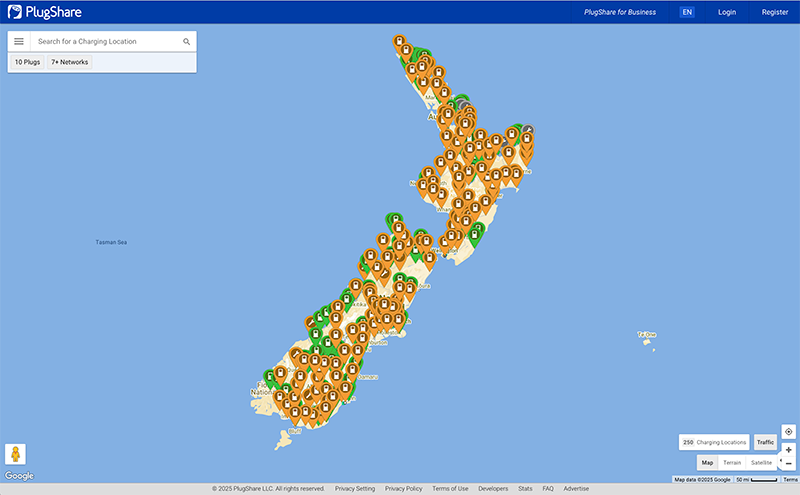
With rural areas still having very limited access to chargers, many EV drivers still fear being left without charge on long journeys, but there are several websites and apps dedicated to making your charging needs as easy to plan as possible. We like PlugShare, which gives easy-to-access, real-time information on charging point coverage and compatibility across New Zealand.
Another useful map is the one featured on the ChargeNet website, which also gives clear information on all of the charging points and their availability status, however it only covers the points within their own network.
The government also has a helpful, online tool ‘Journey Planner’, which enables you to plan your journey with adequate charging points along any given route.
Those who can afford to purchase a new EV, and may even be completely happy with the availability and ease of charging, may still have concerns over the range current models can offer and the whole life of the battery.
The reason charging availability has remained such a significant issue is partly down to the physical distance one full charge can take you, otherwise known as an EV’s ‘range’ and the so-called ‘range anxiety’ EV drivers can feel. While there is still progress to be made, these figures have improved massively over the relatively short time EVs have been available.
When we published the first version of this blog a few years ago, the average number of kilometers an EV could travel in a single journey was around 150, with the ‘top end’ Tesla S boasting over 640km on a single charge, which of course is still an impressive figure today! According to experts, the average range of an EV is now 380km, which also takes into consideration real life factors such as heavy loads, changing speeds, bad weather and hilly terrain, which manufacturers’ advertised range figures don’t.
If and when you choose an EV, while new battery tech is generally good, be sure to look into the real life range mileage figure and ensure it will suit the journeys you will be doing most frequently.

Every type of battery degrades over time. But rather than worrying your EV is going to mimic your mobile phone, you can be assured that, as long as they are treated correctly, most modern lithium-ion units are likely to last the lifetime of the car.
When EVs first entered the mass market many manufacturers specified an 8 year battery warranty, however, data so far has shown the majority of these batteries are outperforming that prediction. Manufacturers keen to offer extra reassurance to customers offered extended warranties on their EV batteries from between 160,000 to 240,000 km. Most also include a maximum allowable capacity; so if their function drops below 70% during the period of the warranty, you’ll receive an automatic replacement. However, not all car models come with a clearly stated maximum degradation threshold from the manufacturer, so it’s worth checking this detail before making a purchase.
There are a few simple things you can do which will have a significant effect on battery life, such as avoiding charging beyond 80% or below 20%, which some EVs manage automatically. It is advised to avoid frequent rapid-charging and in general keeping your battery cool (something to bear in mind if you don’t have sheltered parking in Summer).
More good news is that EV tech is improving all the time and there is some great advice out there whether you’re looking after an older EV or a brand new purchase. We’ve also written a blog on charging and driving your EV efficiently.

Apart from the practicalities we’ve covered, some people’s concerns about EV adoption take them right up to the car’s end-of-life and the issue of recycling. The reality is that while the industry still has a long way to go, EV batteries can and are being recycled effectively and CarTakeBack are already involved in this in several countries.
We continue to invest in training our vehicle recycling partners in how to safely handle EVs and hybrids, as well as sitting on several research boards to support and advise on future end-of-life EV developments, including work with the innovative Faraday Institute. CarTakeBack also supports New Zealand’s ‘BIG’ battery recycling research project.
For now, lithium-ion batteries would have to be exported for recycling, but there is fast progress within the industry and more facilities being established that can safely manage the main stage of processing these batteries. The progress we’ve seen, even in the last twelve months, is great news for the industry as a whole and for members of the public concerned about the whole-life impact of EVs.